Showing posts with label catalog. Show all posts

Tuesday, January 10, 2017

Courage Cube Loving Uplifting Gifts

I just completed a project for Rebecca Daoud founder of Courage Cube. She has suffered from chronic illness since age 29, read her story on her website at https://goo.gl/y5mDi3 (couragecube.com). Here are some of the product proofs done on white sweep. If you know a person or have a family member suffering from an illness, consider these gifts to support them.

Close ups of some of the included gifts.


Complete gift sets.


Basic catalog photos on white sweep that will be easy to knock out later for use on Amazon or mixed media advertising.

#product #photography #tampabay

Tuesday, July 26, 2016

Shooting for color accuracy!

Part of the challenge in product photography which seems less critical in other types of photography is getting the colors spot-on. Using color control software, color balanced lighting, calibrated monitors and camera gear can get you pretty close, but, sometimes you just have to physically match the resulting photos to the product. The following set were a battle because even a slight contrast change threw color accuracy out the window.

Light pastels can cause color control software
to try to boost the contrast to seperate the light tints
from the white elements increasing color saturation 
and color shift.


Here the hardest color to render correctly in JPG is usually full
saturation red.


I always guarantee correct color rendering in a given color space. Sometimes a brief discussion on color theory and monitor calibration with the client is necessary to explain why colors look different on their phone's screen from their desktop computer. More on color calibration here https://en.wikipedia.org/wiki/Color_calibration

Having trouble deciding weather to out-source or in-house your product photography?
Reading this article will help you decide. http://bit.ly/29U9VlO

Saturday, July 16, 2016

I have run into group of marketing articles which convey the importance of quality product photos rather than attempt to rewrite the information I thought I would just re-publish the links here. The message is, without fail, use the best quality photos you can be it DYI or commissioned from a professional.
Enjoy...


The Do's and Don't of Product Photography - http://bit.ly/29PmDog
Hiring a Professional Photographer to Photograph your Products - http://bit.ly/29L3QrH
How to Drive Sales With Effective Product Photography - http://bit.ly/29Y96cr
Why Presentation and Context Are Crucial to E-Commerce Product Photos - http://bit.ly/29OT9Go

Wednesday, April 27, 2016

T-shirts and that hollow look

Clothing can be very challenging and expensive to shoot. Take that empty shirt floating on white look. That's where the garment looks like it is being worn but just floats there in a surreal pose with nothing inside.  Not hard to do with Photoshop and other image editing software. Dress the model in the outfit, photograph in front of a white background. Photograph fill in shots of the back collar and sleeves. Bring it all into Photoshop and 30 minutes later there is a garment floating in the air being worn by the invisible man(woman). I have done this before but the end result always is a bit, well, creepy...My personal preference is to leave the model in or just use a display mannequin designed for in-store use.
Shot to Amazon specs.

Friday, February 19, 2016

Those Darned Shinny Surfaces!

From jewelry to water filters(?) Package and product designers love to use clean polished surfaces to give the product an up-scale appeal and it works for the most part. Hey,lets face it, we love the shinny. It's amazing how human vision can cloud the details of what we really see for what we want to perceive. 
In a store we see the chrome cap on that bottle of cologne as a shinny silver embellishment. We seem to ignore the fact that that little piece of silver is mirroring back all the objects in the area. From the sales person to all the fixtures and lighting are reflected in this little mirror. Our eyes see this visual "noise" and our brains filter it out as extra information we don't need. Examine a photograph of that bottle taken in the same place and distance, suddenly we see all the little reflections and imperfections. Our eyes are drawn to them as a moth to a bright light. When we examine a photo our full attention is focused on the item without any other distractions. Our brain shifts gears and we begin to focus on the details of the product. 
As a product photographer it's my job to photograph that shinny without any distracting reflections and still show a shinny surface without the use of software fixes which tend look faked. I have spent years learning and experimenting with the shinny enough to know that each item presents it's own set of problems and solutions. Here is an example of a shinny object that, while not being a mirror, still reflects all that is around it.
A big shinny cylinder!

Keeping some of the unevenness in the reflections helps to define the objects shape and how smooth the surface.
Having trouble with your "shinny"? I can take out the stress of the shinny. Give me a call.  

Sunday, November 29, 2015

The Holidays Are Here!

Many of our prospective new clients are gearing up for the Holidays and I have been busily doing the salesmen routine explaining our service and what a use license is and why there are set-up fees. As often as I am explaining these aspects of the business I thought I would boil it down to the core concepts here.

First, use licenses.
Licensing can be a very complex and tortuous legal web with image use being highly restrictive as to when, how long, what geographical region use is restricted to (local or international), and even what media the images are used in (print, web, billboard, TV to name a few). This type of license are covered under a broad description of "Rights Managed". ProdPhoto.com uses the simplest licensing scheme of all, "Stock License". The essentials are that you as the client can use the images in any media, in any location, for as long as you want. No recurrent fees or charges.
Next, set-up fees.
Set-up fees vary from job to job but generally cover the cost of dressing the studio for your job. It can include consumables (wear and tear on equipment, mounting wax, strobe bulbs), special order props( pink background paper?) and special equipment rentals(lenses, strobes, mannequins)  typically used only for one project.

Here are some Holiday decorations I just finished that didn't require much in special equipment but took considerable time in set-up. Everything had to be glued down and positioned exactly.

Group shot on a glass sheet.


Everything has been glued in place.


Lifestyle

Friday, October 23, 2015

Maker

It's nice to see that the Tampa Bay area has a strong community of inventors and entrepreneurs. Local inventors produce everything from medical appliances to pet products which brings me to our new client, Smarter Reefs, who make specialized aquarium gear for exotic fish needs. His patented fish feeder is made of clear acrylic polymers making for a challenging set of photos,  pure white background hi-key photos for the up coming web site. Here are the mounting base and feed tubes final shots.

Problem: how to separate the transparent edges from the background
Solution:Use split lighting on the background and subject


The final shot

Friday, July 10, 2015

Really Cool Stuff from Kenya!

Welcome "Stuff from Kenya" to the ProdPhoto family! Stuff from Kenya imports upscale handcrafts directly from the craftsmen and craft-women. Unique leather goods, belts and handbags all one of a kind and a beautiful addition to any wardrobe. The website is not yet up  but you can visit them on Facebook at: http://www.facebook.com/StuffFromKenya and buy on-line through eBay.
Just started with the composition and lighting for the belts. Not complete yet but here is a sample.
Shot to Amazon's strict standards.

Close up detail of the deft hand work
securing each bead to the belt.


Thursday, April 30, 2015

Imported Jewelry and Imaging for Amazon

With the explosion of jewelry vendors vying for Amazon's attention Amazon.com has had to tighten up what is considered the primary product image rules for acceptable use. Hence the 20 page long Jewelry Style Guide. While Amazon has always had these guidelines in place, certification staff has really been towing the line and images that may have squeaked by in the past won't cut it anymore.
White means white period. Not RGB 254,254,254 but 255,255,255, and sharp as a tack front to back. Quite a challenge when we are working with macro distances. This means shooting at f/22 or higher and requiring gobs of quality light only possible with very powerful (and hot) continuous halogen lights or pricey studio quality strobes.  We choose strobes. The halogen lights are so hot they overpower the A/C and heat the studio to uncomfortable levels in about an hour.
Following are an example of some rejected images.
 Wrong layout, focus, and not on white.

Not on white and focus.


All of the above would be ok for Ebay, Craig's List and other auction sites, but they fall short because of some technical flaws. We noticed the colors on the failed images were a bit off which may  have caused customer satisfaction issues because the images don't actually reflect the products true colors.
Here are the approved shots the client had us do after the in-house method failed. (Please note: there is always some color shifting because of individual monitor/browser rendering.)


Following the style guide the background measures
255,255,255 and everything is in focus. Colors
are calibrated and 100% accurate.


Sunday, March 1, 2015

and now for something completely different..

decals, and not just your everyday run of the mill standard flat bumper sticker types, these are 3D and look really special. The hard part is to make these look as good in a photo as they do in real-life. The task is to shoot the 4 colors on a neutral white  at several different angles to show off the raised texture unique to this product. The problem is to keep the background uniformly lit. 


Initial shot with minimal post processing. Notice the slight
color variation caused by a slight difference in the color
temperatures of the lights from left to right (cooler lamp
on the right). Something we'll fix in the finals.


The solution was to raise the decals on a glass sheet 6 inches above the background and light the subject and background separately. 2 lights for the product and 3 lights for the background. A mono-light with a 24 inch softbox from camera right to light the product and the right side of the background. A mono-light with a 2 inch snoot off camera left to provide hard shadows showing off the texture and spilling onto the left side of the background. Finally a speed light with a 12 inch softbox to smooth out any shadows on the background. 

The angles shots required a different approach. The background showed an annoying drop shadow from the samples so we placed the product directly on the white background material. This got rid of the drop shadow but required  more post processing in Photoshop.

The small shadow in this series helped bring out the 3D design.

Tuesday, January 13, 2015

We Love the Small Jobs

Small jobs usually afford much more creativity on the photographer's part because there is usually no creative director, art department or brand guides to follow. The budget just isn't there. These new entrepreneurs are usually a "one man band" doing all the work to launch a fledgling business. At some point the product needs to be photographed for the web, catalogs, and other advertising. These clients tend to rely on us for design and style choices unlike the more directed projects. These clients have a general idea for how the product should be presented but it falls on the photographer to bring the vision into focus. The job is to shoot the product and design a table stand graphic for use in various upscale salons.

Here the client supplied a photo of
where these displays will be used. 

The client vision was a silver toned image. We shot the product against a silk curtain leaving the folds in view  to give a slightly soft feel to a spartan design.

After a few trial product layouts, here is the final design.

The final display design.

Done in about a day, we had fun playing with the ideas and implementation. 


Saturday, December 20, 2014

We would like to welcome Dixie Belle Paint to our family of clients. We have been commissioned to update their extensive catalog of products with professional true to color catalog shots on white sweep and compose a series of environmental shots showcasing the country craft quality of the product.

Primary line of  27 paints including colors like "Florida Orange" and "Flamingo"

Natural China hair brushes.

Shooting bottled product on a white sweep is not particularly difficult, but, keeping colors accurate can be a challenge. Here the black glaze is actually blue before the coating dries. Having a fully color calibrated equipment and workflow is the key to faithfully reproducing the unique colors in this or any other product line. Controlled lighting with a known color temperature, 6500°K, is only one part of the mix. A fully calibrated camera and workstation are also required.

Glazes and clear coats.

Glaze close up detail shot.


The camera is custom balanced to a standard gray card and also RGB values are calibrated to a known standard to keep the shots consistent across the entire range of hues and re-calibrated before each set change. The workstation is calibrated weekly with a colorimeter. We use only one workstation for final processing to eliminate any hardware variables that could slip into the process.

Kudzu green.

Kudzu green with neutral gray card.

The white sweeps are actually shot to light gray to stay consistent across the product line and allow the white colors to stand out more. There is more than enough separation to "knock out" the products if needed later.

Monday, October 27, 2014

New Product Launch - Natural Sponge

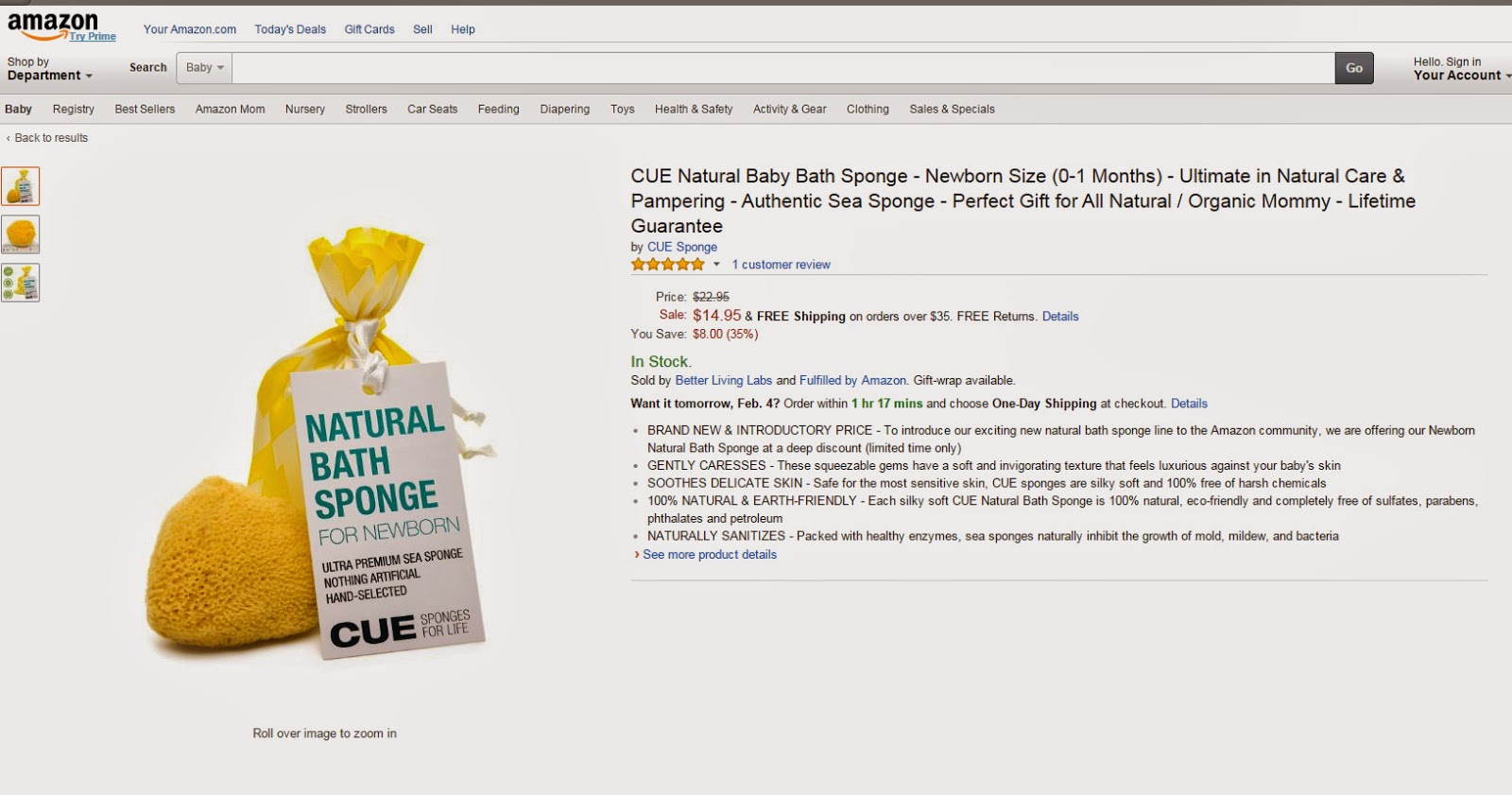
The client is starting a new line of products on Amazon and has to be shot to Amazon's specs. Not the most glamorous work, but important. Not all jobs afford you the greatest creative latitude, sometime  you just shoot to spec.
Natural sponges are becoming all the rage after many years of declining sales. Tarpon Springs Sponge Docks (http://www.ctsfl.us/) is about the only place where sponge diving survives in the USA to this day and one of my favorite places to visit in the local area. So I was very happy to get the opportunity to shoot  this new line for Better Living Labs (http://www.betterlivinglabs.com). All the sponges are sourced and hand picked directly from vendors in this small community.

Local gift shop at the docks displays a variety
of Grass and other sponges

Sponges range in quality and variety from decorative Grass Sponges to the smaller tightly celled Wool Sponges used mostly in cosmetics and in the healthcare industry. 

This may be a small job for the studio but it deserves all the care and attention demanded by our larger clients. The client wants the colorful packaging to shine and the quality of the product to come through for this series shot to Amazon's catalog specs. (shot on white sweep w/o any props). Here is a sample of the initial proofs.

Just a modest amount of post processing, basically 
strait out of the camera.
With items like this I like to shoot with a light meter. Lots of white will fool the camera light sensor into under exposing the shot where an incidence meter can not be fooled.

And some of the finals...


Sponges on Amazon